Construction Management ERP System
FCP Insight
Internship
B2B
ERP SYSTEM
Optimizing operational efficiency through system redesign for a B2B internal management system.
COMPANY
TIMELINE
Jan, 2026 -Present
ROLE
Lead Designer
TOOLS
Figma (AI Plugins) , Figjam, Stitch, Claude Code
Overview
FCP Insight is a B2B construction platform for project and resource management. As the product expanded, its interface became a dense collection of tools that users navigated through habit rather than intuition. A redesign was needed to improve operational efficiency and better support the daily workflows of staff, technicians, and managers.
My Role
I am the Sole UI/UX Designer on this initiative. As a newcomer to the construction tech space, I am responsible for the end-to-end process: from conducting foundational user research and mapping technical workflows to delivering the final UI/UX specifications.
Making Sense of Complex Ecosystems
The Challenge
Invisible Friction
Internal users have developed 'workarounds' and no longer 'see' the friction
Ambiguity to Action
Shift from traditional research methods to observing flaws in workflow logic.
High-complexity
High frequency & complexity interactions require a balance between density & clarity
The primary hurdle wasn't just a dated UI; it was "invisible friction." Internal users have used the system for so long that their workarounds have become muscle memory. Because they no longer "see" the problems, traditional interviews resulted in ambiguous data. I had to shift my strategy from asking users what was wrong to observing exactly where their workflows broke down.
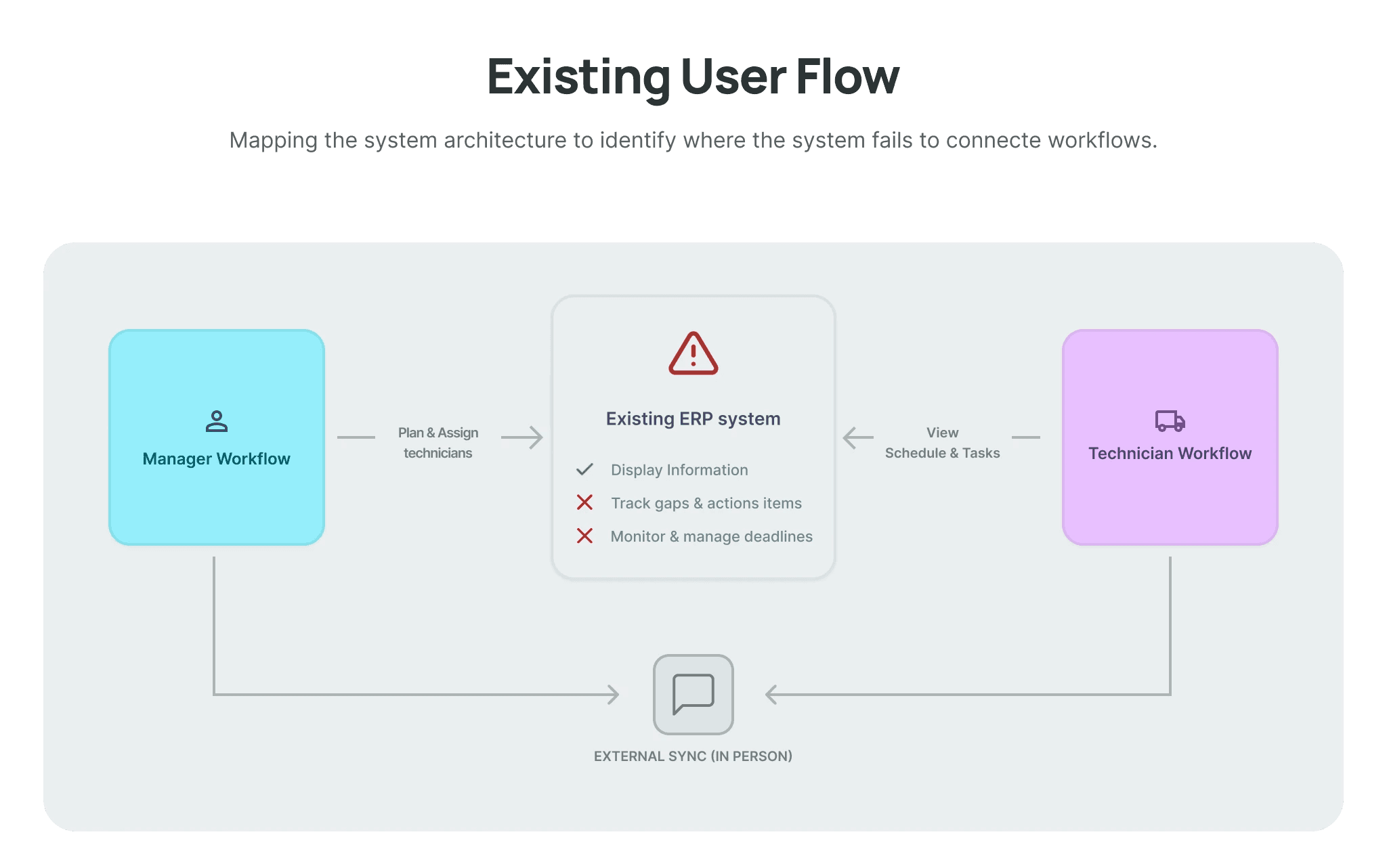
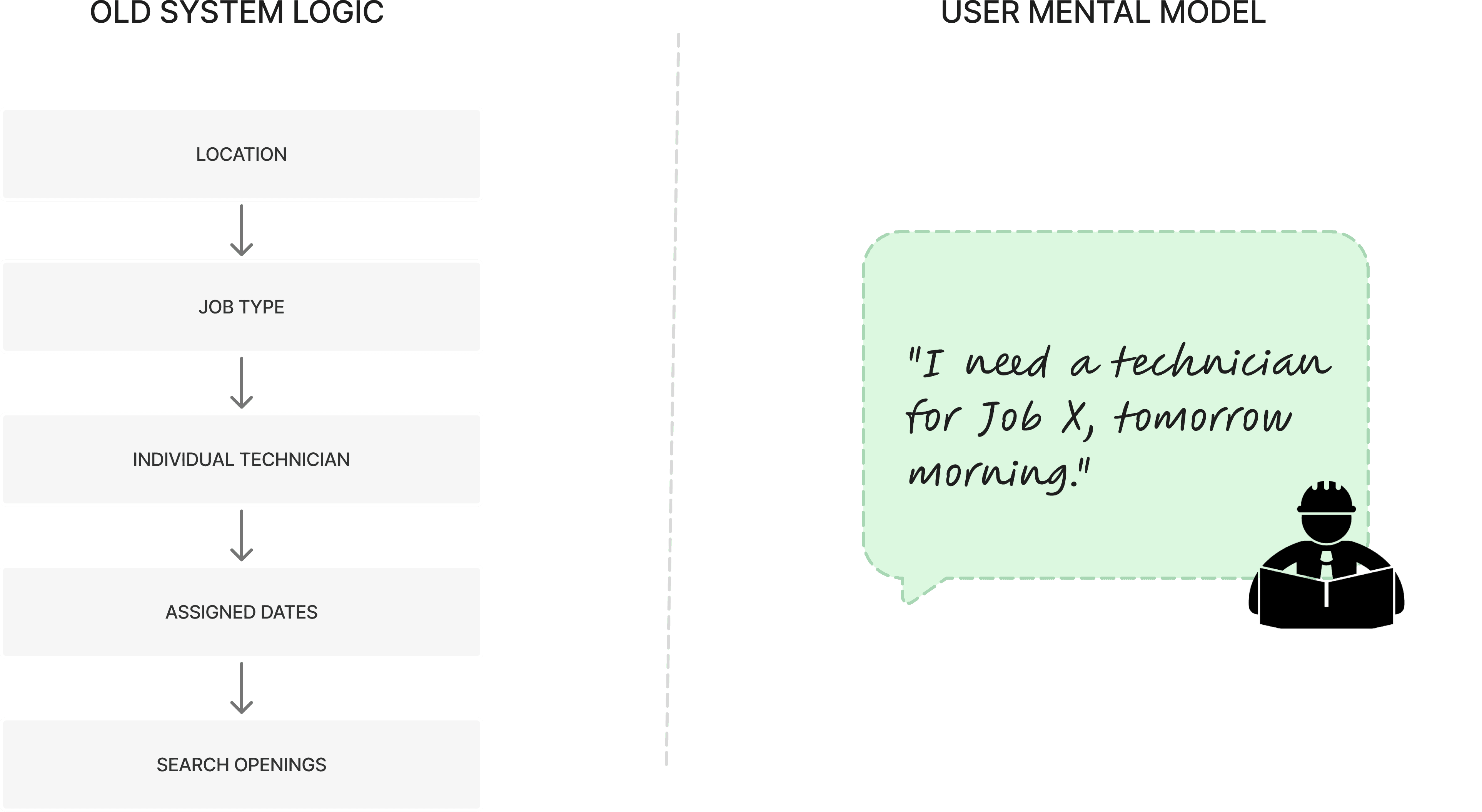
The existing gap had forced teams to rely on in-person communication between technicians and managers as a workaround: a signal that the interface wasn't doing its job. Targeting this first would reduce operational friction immediately and establish a more coherent, documented workflow for both roles.
The Discovery Journey
User Stakeholder Interviews
Surveys and interviews with various user base including technicians, project managers and site leads
Audit of Legacy Logic
Breaking down interdependent screens an workflows to understand the underlying data relationships and logic gaps.
Information Architecture Redefinition
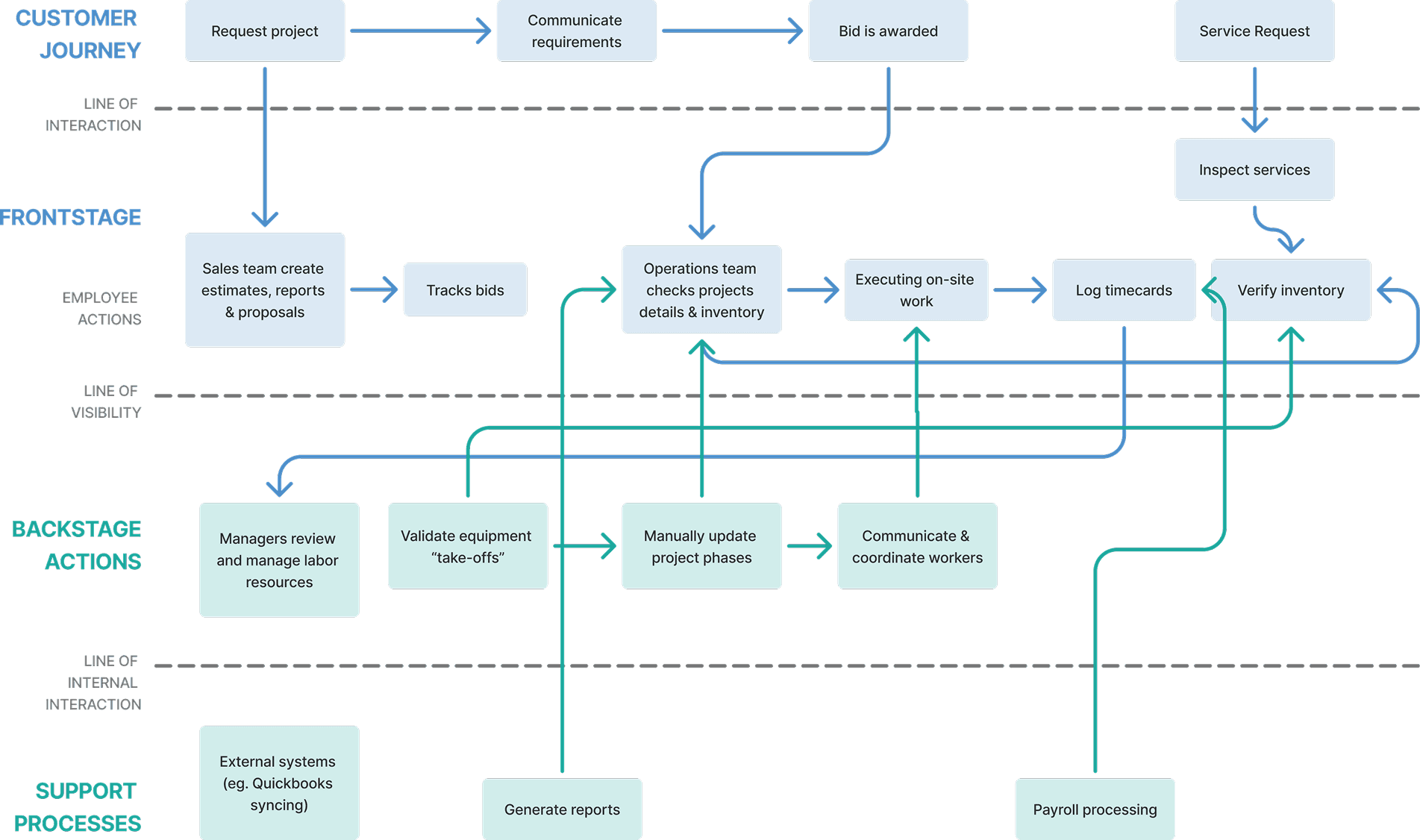
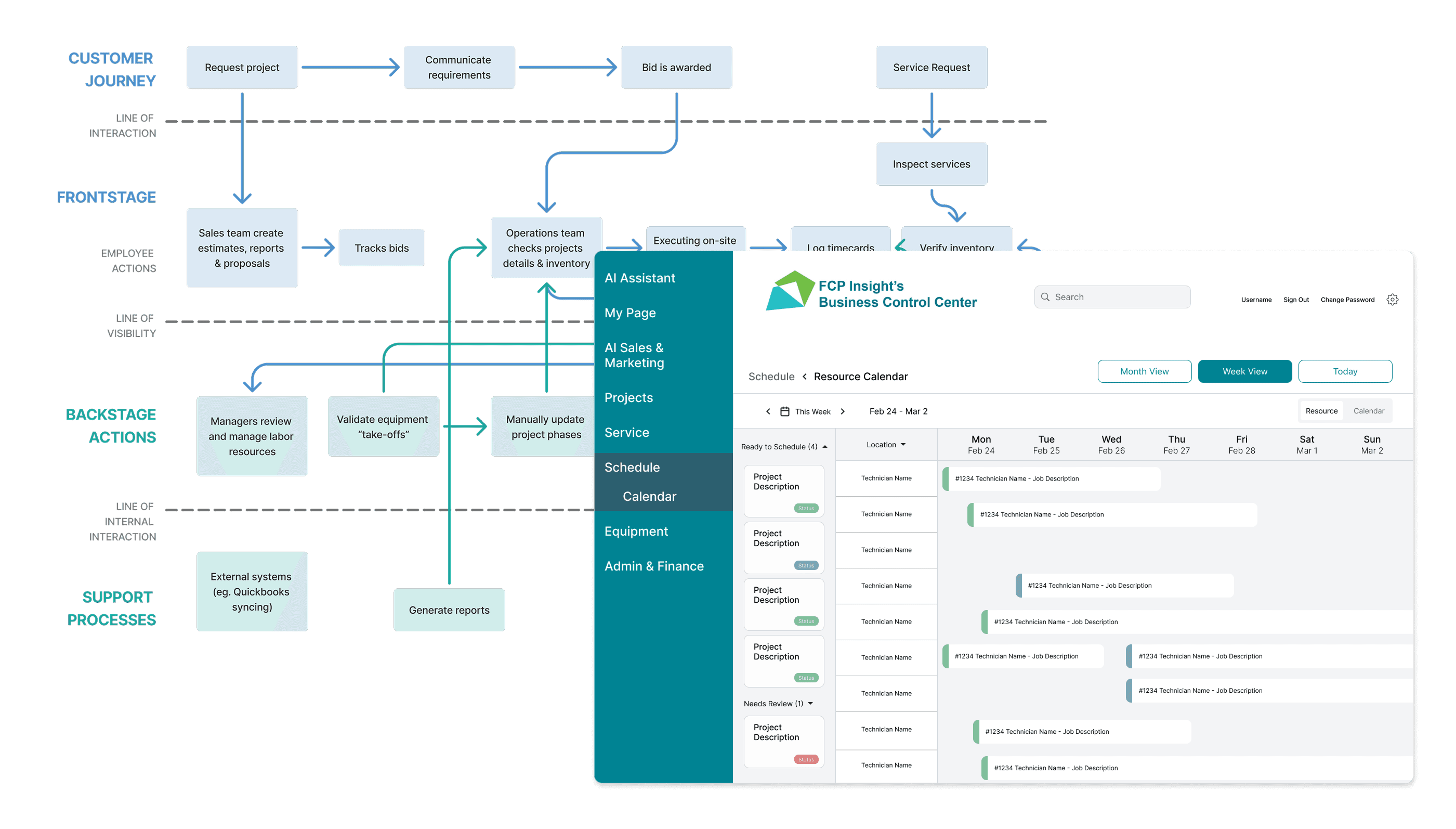
Service blueprint Map
My Design Focus
My work centered on redesigning the existing system to bridge workflow gaps across coordination, resource management, and communication. Following in-depth research, I identified scheduling as the primary integration point to address these gaps.
Strategic Workflow Alignment
Balance density and clarity for high-complexity tasks
Agile Rapid Prototyping
Quickly translate concepts into prototypes to accelerate feedback loops
Modular Scalability
Building solutions that solve immediate problems while laying the foundation for long-term system architecture
Key Design Decisions
Decision 1: Combining Resource Management + Calendar Views
Before: High Navigational Friction
Having two separate calendar tabs nested under a parent tab forced users to click back and forth to find schedule openings, causing confusion.
Now: Unified Flow
Consolidated the separate tabs into a single dashboard so users toggle between the Resource and Calendar views, streamlining scannability and reducing clicks.

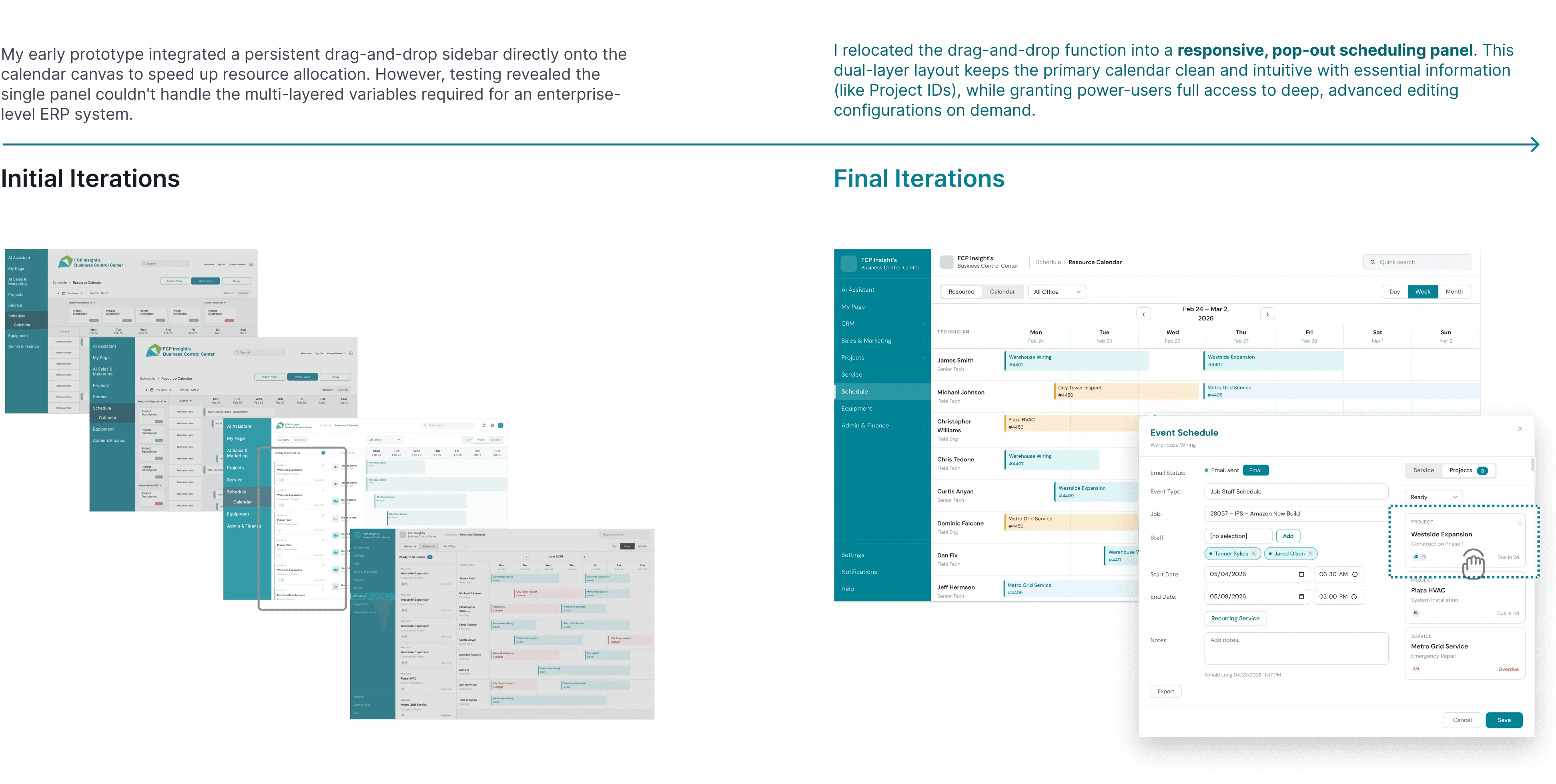
Decision 2: Introducing Drag & Drop Interactions
Before: High Cognitive Load
To move a project, users had to possess prior knowledge of which projects were ready, relying entirely on memory to recall and manually search for specific project numbers.
After: Visibility
Implemented a side expandable project panel to provide visual, on-demand project data that users can drop directly onto the calendar.
Explored Solutions:


Outcomes
We're still in progress, but the impact has already been meaningful. I aligned stakeholders around a shared understanding of system friction using service blueprints and workflow maps. I turned invisible user habits into a documented list of functional requirements. And I've established a consistent design system and modular architecture that shifts the team from patching surface-level bugs to building for long-term efficiency.
Aligned Stakeholders
I mapped out current state service blueprints and workflows to create a shared mental model of system friction among all stakeholders.
Reduce Uncertainty
Turning "invisible" habits into a documented list of functional requirements for the next phase of development.
Established Scalable Foundations
Transitioned from fixing surface-level bugs to building a consistent design system and modular architecture that supports long-term efficiency.
Next Steps
As the redesign moves toward implementation, future work will focus on:
Refining High-Density Modules: Finalizing the combined resource and scheduling calendar views based on feedback from the latest round of sacrificial wireframes.
Design System Expansion: Scaling the established UI patterns and branding to cover secondary modules, ensuring a cohesive experience across the entire B2B platform.
Validation through Usability Testing: Conducting structured testing on the new modular workflows to measure improvements in efficiency and a reduction in "invisible" friction
What this project has taught me most is how to bring clarity to complexity. In a domain I had no prior knowledge of, I had to earn the trust of stakeholders, learn an entirely new industry, and design systems that work for people who didn't even realize what they needed. That's the part of UX work I find most challenging — and most rewarding
More to be updated…